What are CRM Tools? Meaning, Types & Business Benefits

CRM tools are software solutions that help businesses manage their relationships with customers, leads, and prospects in one organized place. Instead of using spreadsheets or multiple disconnected apps, these tools bring all customer information into a single system.
Studies show that over half of businesses see better customer satisfaction and stronger customer retention after using CRM tools, which explains why more companies rely on them today.
From tracking conversations to managing sales follow-ups and storing contact details, CRM tools help businesses stay connected with the right people at the right time. They reduce manual work, improve errors, and make communication smoother across email, phone calls, and social media platforms.
Meaning of CRM Tools in Simple Words
CRM tools stand for Customer Relationship Management tools. These tools help businesses store customer information, track interactions, and manage communication across email, phone calls, social media, and websites.
Instead of keeping customer details in notebooks, Excel sheets, or scattered apps, CRM tools bring everything into one system. It makes work faster, cleaner, and more accurate.
At their core, CRM system tools focus on three main goals:
Knowing your customers better.
Communicating with them at the right time.
Building long-term relationships.
How CRM Tools Work Step by Step
Most CRM tools follow a simple flow that fits into daily business work.
Capture customer data from forms, emails, calls, or social platforms.
Store all details in one dashboard.
Track every interaction automatically.
Assign follow-ups to sales or support teams.
Analyze data to improve decisions.
This automation reduces manual work and avoids human errors.
Why CRM Tools Are Important for Businesses Today
Customer expectations are higher than ever. People want fast replies, personal messages, and smooth experiences. CRM tools help businesses meet these expectations without stress.
Here is why they matter:
- Customers do not like repeating the same information.
- Sales teams need clear follow-up reminders.
- Managers need reports to track performance.
With the right CRM, all this becomes simple and organized.
Types of CRM Tools You Should Know
There are different types of CRM systems tools, each designed for a specific business need. Understanding these types helps you choose the right one.
Operational CRM Tools
These tools focus on daily business tasks like sales, marketing, and customer support.
Key features include:
- Contact management.
- Sales pipeline tracking.
- Email automation.
- Support ticket systems.
Most small and mid-sized businesses start with this type.
Analytical CRM Tools
Analytical CRM tools help businesses study customer behavior using data.
They help with:
- Sales trend analysis.
- Customer buying patterns.
- Campaign performance tracking.
This type is helpful for businesses that want data-driven decisions.
Collaborative CRM Tools
These CRM tools improve teamwork across departments.
They allow:
- Sales and support teams to share customer data.
- Marketing teams to align campaigns.
- Faster internal communication.
It ensures customers get a smooth experience across touchpoints.
Standard Features Found in CRM Tools
While features vary, most CRM tools offer some core functions.
- Central contact database.
- Activity and task tracking.
- Email and call logging.
- Lead and deal management.
- Reports and dashboards.
Advanced tools may also include automation and AI-based insights.
CRM Software Examples Used by Businesses
Looking at real CRM software examples helps make the concept easier to understand.
Common CRM software examples include:
- Sales CRMs are used to manage pipelines and deals.
- Support CRMs used to track customer issues.
- Marketing CRMs are used for email campaigns and segmentation.
These tools are used across industries like retail, IT, healthcare, finance, and education.
CRM Tools Examples vs Lead Generation Tools
It is essential to understand the difference between CRM tools examples and lead generation solutions.
CRM tools focus on:
- Managing customer relationships.
- Tracking interactions.
- Handling follow-ups and deals.
Lead generation tools focus on:
- Finding the right prospects.
- Verifying contact details.
- Preparing leads for outreach.
CRM tools and lead generation tools are designed to work together, not replace each other.
Before a Lead Reaches the CRM
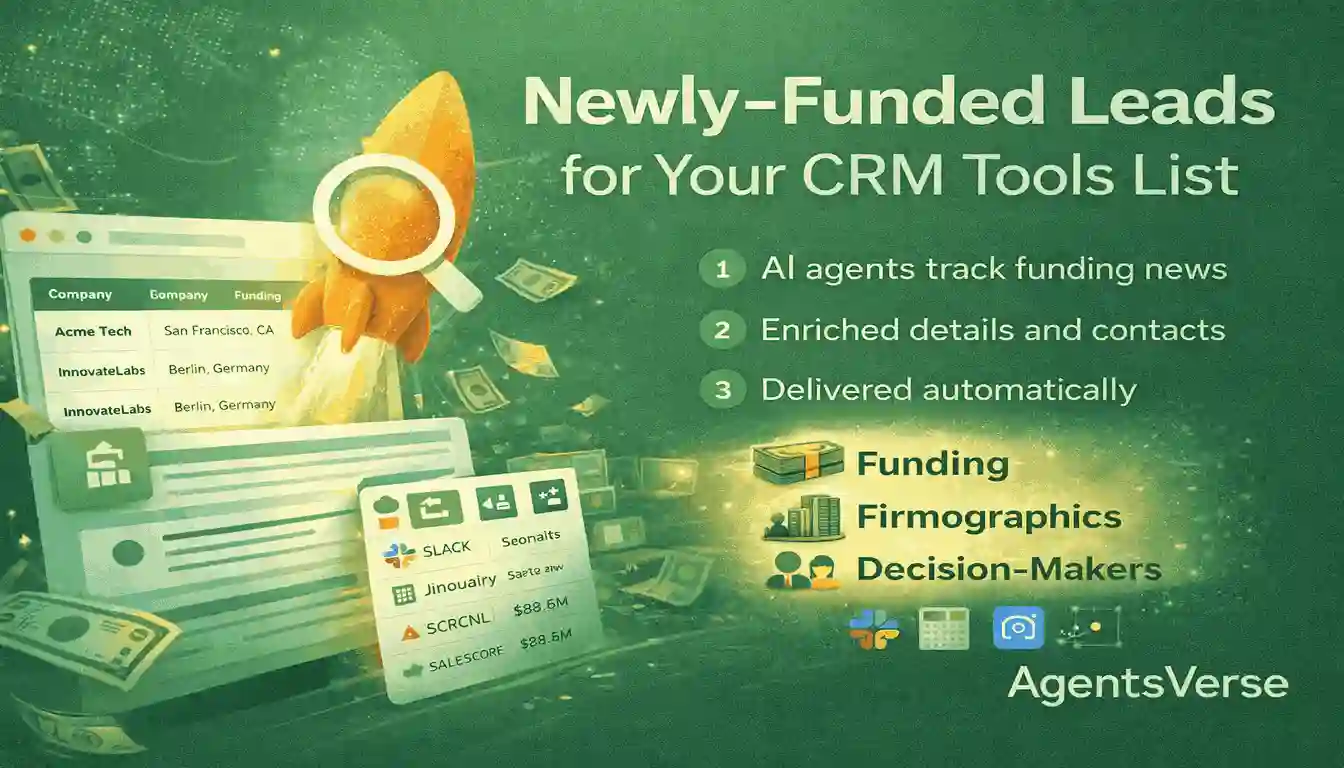
A CRM becomes most useful after a prospect has been identified. Before a lead reaches the CRM, the prospecting workflow needs to identify a meaningful signal, find the right company, identify the relevant decision-makers, enrich and verify their contact information, and only then send the record into the CRM.
This is the role of lead generation before CRM management begins. AgentsVerse Cloud combines B2B data enrichment with automated lead generation so sales teams can send cleaner, outreach-ready records into their CRM.
AgentsVerse Cloud as a Lead Generation AI Agent for Just-Funded Companies
AgentsVerse Cloud is not a CRM tool. Instead, it works alongside CRM tools by delivering high-quality, outreach-ready leads before they enter a CRM system. It helps sales and outreach teams focus on the right companies at the right time.
Rather than managing customer relationships, AgentsVerse Cloud focuses on answering three key questions:
- Who should you contact?
- When should you reach out?
- How can you reach them accurately?
How AgentsVerse Cloud Replaces Multiple Outreach Tools
Many teams use several tools just to prepare leads for outreach. One tool to track funding announcements. Another way to find contacts. Another for enrichment. One more for email verification.
AgentsVerse Cloud replaces funding monitors, data enrichment tools, and email verification tools by combining all these steps into one automated workflow.
What AgentsVerse Cloud Actually Does
AgentsVerse Cloud is designed for outbound and sales teams targeting just-funded companies all over the world.
Key capabilities include:
Leads only from recently funded companies, not outdated databases.
Around 600 leads per month, shared daily.
Slightly fewer leads on weekends, as funding announcements rarely happen on Sundays.
Verified and enriched contact details, including emails and LinkedIn URLs.
Fully automated data discovery, enrichment, and verification.
For marketing teams:
It ensures teams work only with accurate and fresh data.
How AgentsVerse Cloud Works with CRM Tools
AgentsVerse Cloud strengthens CRM tools by supplying clean, verified leads that are ready for follow-ups and deal tracking.
Once leads are generated, they can be pushed into CRM platforms for:
- Sales follow-ups.
- Pipeline management.
- Relationship tracking.
AgentsVerse Cloud also offers HubSpot integration, which makes syncing leads with CRM systems even easier.
CRM Tools List Based on Business Needs
A good CRM tools list depends on what a business is trying to achieve.
For sales teams:
- Lead and deal tracking.
- Automated follow-ups.
For marketing teams:
- Campaign tracking.
- Audience segmentation.
For support teams:
- Ticket management.
- Customer history tracking.
For outreach teams:
- Lead generation tools like AgentsVerse Cloud.
- CRM tools for follow-up and relationship management.
Simple CRM Examples for Everyday Use
Here are a few easy CRM examples:
- A sales rep uses CRM to track follow-ups.
- A support agent checks past issues before replying.
- A business owner reviews sales performance reports.
These examples show how CRM tools fit into daily business operations.
Benefits of Customer Relationship Management for Businesses
The benefits of customer relationship management go beyond just storing data.
-
Better Customer Experience
CRM tools help businesses reply faster and more personally. Customers feel valued when their history is remembered. -
Improved Sales Productivity
Sales teams know who to contact, when to follow up, and what to say. It improves conversion rates. -
Centralized Data Management
All customer data stays in one place. It reduces confusion and errors. -
Smarter Decision Making
Reports and dashboards show what is working and what is not. -
Cost and Time Savings
Automation reduces manual work. Teams can focus on selling and serving, not data entry.
CRM Tools for Small vs Large Businesses
Small businesses use CRM tools to stay organized and grow steadily. Large businesses use them to manage complex processes and big teams.
The core goal remains the same. Build strong customer relationships.
How to Choose the Right CRM Tools
Before choosing from a long CRM tools, ask these questions:
- What problem do you want to solve?
- How big is your team?
- Do you need automation?
- Will it integrate with your existing tools?
Simple needs require simple CRM tools. Advanced outreach needs more innovative solutions like AgentsVerse Cloud.
Final Thoughts
CRM tools play a key role in managing customer relationships, improving communication, and increasing sales efficiency. They help businesses stay organized and deliver better customer experiences.
Lead generation AI agents like AgentsVerse Cloud complement CRM tools by handling the discovery, enrichment, and verification of leads. Together, they create a complete and efficient sales workflow.
Choosing the right combination of CRM tools and lead generation solutions helps businesses grow faster while staying focused on what matters most: their customers.
To know more, explore the AgentsVerse Cloud expert blog section!
FAQs about CRM Tools
1. What are CRM tools, and why do businesses use them?
CRM tools are software solutions that help businesses manage customer data, track interactions, and handle sales and support activities in one place. Businesses use them to stay organized, improve customer communication, and increase sales efficiency.
2. Are CRM tools the same as lead generation tools?
No. CRM tools manage relationships after a lead is captured, while lead generation tools focus on finding and preparing new prospects. Lead generation AI agents like AgentsVerse Cloud work before CRM tools by identifying just funded companies and providing verified contact details.
3. What are some common CRM software examples?
Popular CRM software examples include tools for sales tracking, customer support management, and marketing automation. These tools help businesses manage leads, deals, emails, and customer service tasks efficiently.
4. Can AgentsVerse Cloud be used with existing CRM systems?
Yes. AgentsVerse Cloud works alongside CRM tools by supplying clean and verified leads. These leads can be synced into CRM platforms for managing pipelines and customer relationships. HubSpot integration is also available.
5. What are the main benefits of customer relationship management?
The key benefits of customer relationship management include better customer experience, improved sales productivity, centralized data management, faster follow-ups, and more intelligent business decisions based on real data.
Ready to Transform Your Lead Generation?
Join founders and GTM teams using AgentsVerse Cloud to find just-funded companies daily.
Start a trial →