
Clay vs ZoomInfo: Features, Pricing & Honest Comparison

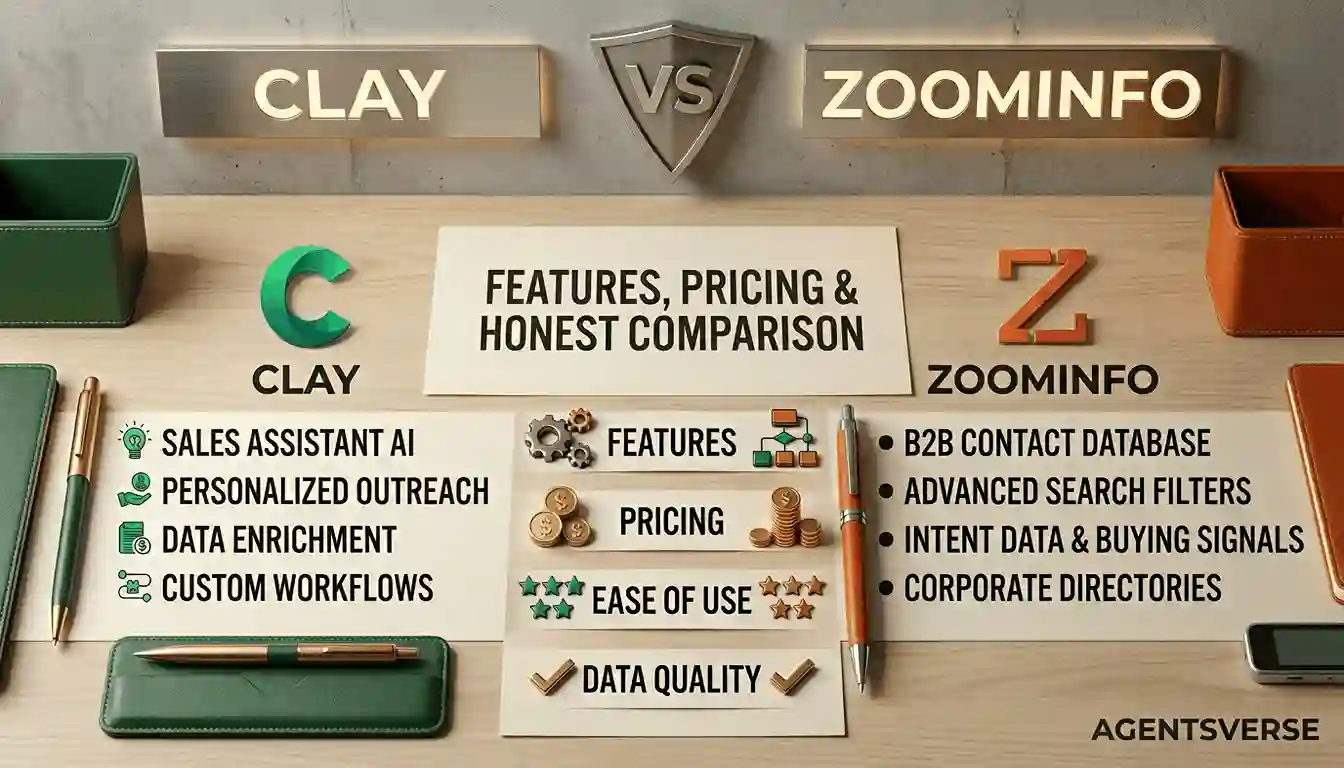
Clay vs ZoomInfo is a common debate for teams that want better data, faster outreach, and smarter automation. Both tools help you find leads and enrich data, but they work in very different ways.
If you are trying to pick the right tool for your business, this informative blog will help you understand everything in simple terms. We will compare features, pricing, pros and cons, and also look at a smarter option that replaces multiple tools at once.
What Is Clay and How Does It Work?
Clay vs ZoomInfo starts with understanding what Clay actually does.
Clay is a data enrichment and workflow automation tool. It helps you pull data from many sources and build custom workflows for outreach.
Key Features of Clay
Pros of Clay
Cons of Clay
What Is ZoomInfo and How Does It Work?
In the Clay vs ZoomInfo comparison, ZoomInfo is a more traditional B2B data platform.
ZoomInfo gives you access to a large database of companies and contacts. You can search, filter, and export leads easily.
Key Features of ZoomInfo
Pros of ZoomInfo
Cons of ZoomInfo
Clay vs ZoomInfo: Feature Comparison
Let’s break down Clay vs ZoomInfo based on important features.
1. Data Source and Quality
● Clay
- ○ Pulls data from multiple sources and APIs.
- ○ You control where data comes from.
● ZoomInfo
- ○ Uses its own database.
- ○ Easy to use but less flexible.
2. Automation and Workflows
● Clay
- ○ Strong automation.
- ○ You can build custom workflows for enrichment and outreach.
● ZoomInfo
- ○ Limited automation compared to Clay.
3. Ease of Use
● Clay
- ○ Takes time to learn.
● ZoomInfo
- ○ Beginner-friendly.
4. Data Enrichment
● Clay
- ○ Advanced enrichment using multiple tools.
● ZoomInfo
- ○ Basic enrichment from its database.
5. Pricing Flexibility
● Clay
- ○ Flexible pricing based on usage.
● ZoomInfo
- ○ Fixed and expensive plans.
Clay vs ZoomInfo: Pricing Comparison
Pricing is a big factor in the Clay vs ZoomInfo decision.
Clay Pricing
- ● Offers usage-based pricing.
- ● You pay for credits and integrations.
- ● More control over cost.
ZoomInfo Pricing
- ● Custom pricing (usually high).
- ● Annual contracts.
- ● Can be expensive for small teams.
When Should You Choose Clay?
Choose Clay if:
Clay works best for teams that like control and flexibility.
When Should You Choose ZoomInfo?
Choose ZoomInfo if:
ZoomInfo is better for teams that want speed and simplicity.
The Problem with Both Tools
Even after comparing Clay vs ZoomInfo, there is a bigger issue.
Most companies still use multiple tools for one simple task: outreach.
Here’s what usually happens:
This creates:
Overall, sales teams spend only 34% of their time actually selling, while the rest is lost to manual tasks like data search, enrichment, and admin work.
A Smarter Alternative: AgentsVerse Cloud
If you are looking for the best ZoomInfo alternatives, this is where things get interesting.
AgentsVerse Cloud is not just another tool. It is a complete system that replaces multiple tools at once.
What Makes AgentsVerse Cloud Different?
AgentsVerse Cloud is an:
It focuses on one powerful idea: targeting companies that just raised funding.
Why Just-Funded Companies Matter
Instead of targeting random businesses, AgentsVerse Cloud focuses on companies that recently raised funding.
Why this works:
- These companies have a budget.
- They are actively growing.
- They are open to new tools and services.
This makes your outreach more effective.
Key Features of AgentsVerse Cloud
The key features of AgentsVerse Cloud are as follows:
Daily Just-Funded Leads
- ✔ Get 600 just-funded company leads every month.
- ✔ Leads are shared daily via Slack or WhatsApp.
- ✔ Slightly fewer updates on weekends.
Verified and Enriched Data
- ✔ Get verified, enriched emails.
- ✔ Complete profiles with updated information.
- ✔ No need for manual checks.
All-in-One Platform
Instead of using 5 tools, AgentsVerse Cloud does everything:
- ✔ Company discovery.
- ✔ Contact details.
- ✔ Data enrichment.
- ✔ LinkedIn profile access.
- ✔ Email and phone verification.
Everything is automated.
Automation at Every Step
- ✔ Data collection is automatic.
- ✔ Enrichment is automatic.
- ✔ Outreach preparation is automatic.
You save hours of work every week.
Global Coverage
- ✔ Tracks funding worldwide, not just the US.
HubSpot Integration
AgentsVerse Cloud offers HubSpot integration, making it easier to manage leads directly in your CRM.
Clay vs ZoomInfo vs AgentsVerse Cloud
| Feature | Clay | ZoomInfo | AgentsVerse Cloud |
|---|---|---|---|
| Data Approach | Flexible, API-driven. | Fixed database. | Focused, high-intent data (just-funded companies). |
| Tool Usage | Requires multiple integrations. | Single tool, but limited. | Replaces 5 tools completely. |
| Automation | High | Medium | Fully automated. |
| Targeting | Depends on setup. | Broad targeting | Highly targeted (funded companies) |
Why AgentsVerse Cloud Is One of the Best ZoomInfo Alternatives
When people search for a ZoomInfo competitor, they usually want:
Here’s why it stands out
- ✔ No need for multiple tools.
- ✔ Focus on high-quality leads.
- ✔ Daily updates.
- ✔ Fully automated workflows.
- ✔ Verified and enriched contact data.
It simplifies the entire process of prospecting and outreach.
Real-World Example
Let’s say you want to target companies that just raised funding.
Without AgentsVerse Cloud
You would:
With AgentsVerse Cloud
- ✔ You get ready-to-use leads daily.
- ✔ Contacts are verified.
- ✔ Data is enriched.
- ✔ Everything is automated.
Wrapping Up
Clay vs ZoomInfo is not just about choosing between two tools. It is about understanding how you want to work.
Choose Clay if you want flexibility and control.
Choose ZoomInfo if you want simplicity and a large database.
But if you want to:
- ✔ Save time.
- ✔ Reduce tool costs.
- ✔ Get better leads.
- ✔ Automate everything.
Then AgentsVerse Cloud is a smarter choice.
It is not just a ZoomInfo competitor. It is a complete shift in how modern prospecting works.
And if you are exploring the best ZoomInfo alternatives, the AgentsVerse Cloud option you should not ignore.
To know more, explore the AgentsVerse Cloud expert blog section!
Frequently Asked Questions (FAQs)
1. What is the main difference between Clay and ZoomInfo?
The main difference between Clay and ZoomInfo is how they handle data. Clay focuses on automation and custom workflows using multiple data sources, while ZoomInfo provides a ready-to-use database with basic enrichment features.
2. Is Clay better than ZoomInfo for data enrichment?
Clay is better for advanced data enrichment because it connects with multiple tools and APIs. However, ZoomInfo is easier to use for quick and simple data needs.
3. Why are businesses looking for a ZoomInfo competitor?
Many businesses look for a ZoomInfo competitor due to high pricing, outdated data issues, and limited automation. They want tools that offer better accuracy and more flexibility.
4. What are the best ZoomInfo alternatives available today?
Some of the best ZoomInfo alternatives include tools that focus on automation, real-time data, and better targeting. Platforms like AgentsVerse Cloud stand out by offering just-funded company leads, verified contacts, and full automation in one place.
5. How does AgentsVerse Cloud simplify lead generation compared to Clay vs ZoomInfo?
Unlike Clay vs ZoomInfo, AgentsVerse Cloud replaces multiple tools by offering company discovery, verified, enriched emails, contact details, and automation in one platform. It also focuses on just-funded companies, helping businesses target high-intent leads more effectively.
Ready to Transform Your Lead Generation?
Join founders and GTM teams using AgentsVerse Cloud to find just-funded companies daily.
Start a trial →